Showing posts with label DAVAO DEL NORTE. Show all posts

Monday, October 22, 2012

Panas Falls in New Corella

Panas Falls in New Corella, Davao del Norte

Deeply embedded within the green mountains of New Corella in Davao del Norte lies Panas Falls - a majestic beauty of nature teeming with unspoiled streams of multi-tiered watercourses and cool natural springs that cascade freely into a soothing drop of waterfalls gushing mightily into a crystal-clear catch basin of icy waters surrounded by a lush greenery of floras and faunas and a verdant canopy of fully grown forest trees which serve as a natural shade from the searing heat of the Sun, perfect for a cool leisurely dip particularly in the hot summer months. 

The site is a widely popular summer destination in the province and is frequented by locals and regularly visited by domestic travelers and foreign tourist for river trekking and water adventure. While the Falls and the area that surrounds it remain underdeveloped, Panas has drawn a strong following of nature lovers and outdoor buffs from nearby towns and cities because of the Falls' natural beauty and the many eco-tourism adventures it offers to its visitors. It is nestled in a forest protected area of Barangay Carcor, managed by the municipal government of New Corella. Because of its popularity, Panas Falls has almost become synonymous to New Corella and is considered one of the widely visited and most important eco- tourism attraction in Davao Del Norte.


How to get to Panas Falls

Panas Falls is situated at, and is part of Barangay Carcor in New Corella, Davao del Norte. The site is approximately four kilometers or about 30 minutes drive of mostly bumpy rough roads through the scenic stretch of the countryside from the town proper of New Corella. 

From Davao City, there are buses at the Davao City Overland Transport Terminal (DCOTT) in Ecoland that regularly ply to and from Tagum City, the capital town of Davao del Norte, where several jeepneys bound to and from New Corella are stationed at the Pereyhas Terminal near the Tagum City Overland Transport Integrated Terminal (TCOTIT). At New Corella town proper, there are habal-habal that regularly service visitors for a minimal fee to the site. Davao City to Tagum is about two hour bus ride.

Sunday, February 19, 2012

Christ the King Cathedral in Tagum, Davao del Norte


Christ the King Cathedral

This is the Christ the King Cathedral in Tagum, Davao del Norte which is the biggest cathedral in the Philippines and where the world's largest and longest Rosary can be found. The cathedral sits on a 2 hectare donated land at the corners of Gonzales Avenue and Sobrecary Street in Magugpo, South of Tagum City, about 53 kilometers north of Davao City. It was in built in 1993 solely from donations and took 12 years to finish, in time for the celebration of the silver anniversary of the Diocese of Tagum City in 2005.

Beautiful Sculptures adorn the frontage of the Basilca

Rear portion

The Altar

The Rosary

Weighing at 2,815 kilos, and measuring 85.5 meters long, this giant Rosary is the largest and longest wooden rosary in the world. Each bead weighs 35 kg. It is made of Magcomo or iron wood that is native to the mountains of Davao Oriental and Surigao del Sur. This beautiful artwork, which  was designed by local artist Kublai Millan of Davao City, was originally intended as a project of the Knights of Columbus to commemorate the 25th anniversary of the Catholic Diocese of Tagum City in 2005.

The Cross of the Rosary

Rosary Beads

Tagum City is a First Class City in the 1st Congressional District of Davao del Norte. It was cited by the Philippine Cities Competitiveness Ranking Project as one of the 20 most viable and competitive business sites in the Philippines in 2005. Considered as one of the fastest-growing cities in Mindanao and in the Philippines, Tagum City has become a bustling hub of culture, commerce, health services, and entertainment in the Davao Region, and in the southern Philippine region.

Saturday, September 24, 2011

Banana Beach Resort


Banana Beach Resort is touted as the world's only beach resort within a banana plantation, and it is located in Tagum City, Davao del Norte, Mindanao, Philippines. The resort is nestled within a sprawling 760-hectare banana plantation owned by Hijo Resources Corporation. Its coastline beach spans 4.5 kilometers of a flat and even seabed, which provides guests with popular water activities such as kayaking, skimboarding, banana boat riding, beach volleyball, water trampoline, Frisbee throwing, or simply building sand castles.

Hailed as the most child-friendly resort in Tagum City, swimmers are always in the constant watchful eyes of the Resort's lifeguards who are strategically situated in the beach area. It also has a 60-hectare forest, a playground for children, and a "Spot" where guests can do fishing, and a trail for biking and horseback riding.

Beach grounds

Clustered a few steps from the beach are tropical-inspired cottages, two of which can accommodate up to 25 persons each, and seven smaller huts which can seat 10 persons each.

Another view of the grounds

View of the beach

View of Davao Gulf from the Resort

Kayaking is one of the popular pursuits in water activities

Frisbee throwing is also one of the popular pursuits

The Resort charges a nominal entrance fee for each guest which is fully consumable on food and drinks at the restaurant and bar, but exclusive of rentals for water activities, accommodation, and other amenities. Senior citizens get a 20 percent discount, and children under 12 years old are free of entrance but must be accompanied by adults.

There are two big day cottages which can accommodate up to 50 persons and seven smaller huts with a maximum capacity of 15 persons. There are also 10 tables which can seat six persons each.

Big Cottages

Casitas

For overnight stay, the Resort has several Casitas which resemble a traditional "bahay kubo" but are open like a cabana :  Single Casitas which can accommodate two guests, and seven Family Casitas which can house four guests. Each of the Casita is provided with one to two mattresses and includes a mosquito net for protection. The toilet and bathrooms, however, are for common use: one for men and another for women.

Casitas

Casitas Bedroom

Single Casita


Open Cottage

At the center of these Casitas is an open cottage for dining, meetings, and parties which is surrounded with lush ornamental and flowering plants of various breeds, colors and sizes.

Pool Area

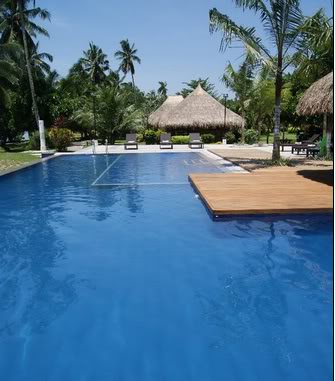
The Pool

The Pool features a sunken bar with seats submerged in the water. Guests can swim and at the same time enjoy refreshing tropical drinks or cocktails while lounging at the sunken bar within the pool area.

The "Spot"

"The Spot" is the most popular place in the Resort where guests can fish for bangus, kitang, lapu-lapu, talakitok, and pompano. It was named as such because guests will have to find their "spot" to do their fishing. It has a huge pavilion where guests can feast on their prized "catch-of-the-day" and other local delights while enjoying the view of the pond, mangroves, and the Madaum River. It is ideal for business events and social gatherings such as weddings, family reunions, debuts, and birthday parties.

Smaller huts around "The Spot"

Aerial view of the "The Spot"

View of the pond and the surrounding towering coconut trees

Not far from the beach is a sprawling 60 hectares of lush forest of trees, bamboos, giant Anahaw trees, and some species of rattan. Guests can avail of a guided tour called the "Twilight Safari" aboard a touring cab provided by the Resort that includes a perimeter survey of the forest where monkeys, wild boars, snakes, monitor lizards, heron, egrets and other birds roam freely. The guided tour is from 5:30 AM to 9 PM.

Or, a tour of the Banana Plantation where guests will have an opportunity to learn the science of banana planting and processing, including a brief history of how the Hijo Plantation started and became the first plantation in the country to export bananas to Japan.

Banana Plantation in Tagum

Group of Macaque monkeys roam freely in the forest

The "e-Walk"

The "e-Walk", or the elevated walk, is the newest forest attraction in the Resort. It is a series of about eight hanging bridges, 22 to 25 meters long each, that are interconnected to huge Dao trees with a ground elevation of about 10 meters. While treading along these hanging bridges, guests will enjoy a scenic view of the inner forest where various animals and wildlife creatures roam freely about.


How to get to Banana Beach Resort

The Resort is located at Barangay Madaum, about 15 minute drive from Tagum City, Davao del Norte, or an hour away from Davao City.

Map of Tagum where Banana Beach Resort is situated along the coastline of Davao Gulf


Contact Information


Banana Beach Resort
Hijo Plantation, Barangay Madaum
Tagum City, Davao del Norte
Tel (084) 400-3358
Mobile +63918-452-1849
and +63917-633-7000
Website www.bananabeachdavao.com


Thursday, July 14, 2011

Rafflesia - World's Largest Flower


Rafflesia - World's Largest Flower

Davao is no stranger to superlatives: Davao City being the largest city in the world, and is home to the largest eagle in the world, and the list goes on. . . And, I would not be surprised that, again, the largest flower in the world called Rafflesia should find its home in the foothill village of New Albay   mountain ranges in Maragusan, Nabunturan, Compostela Valley, Davao del Norte.


Map of Maragusan


 Maragusan, Nabunturan, Compostela Valley, Davao del Norte

Rafflesia is a large parasitic plant discovered in the lush tropical rain forest of Indonesia by an Indonesian guide working for Dr. Joseph Arnold in 1818, and named it after Sir Thomas Stamford Raffles, founder of the British colony of Singapore, and leader of the expedition. The discovery eventually led to more discovery of  27 species in southeastern Asia, on the Malay Peninsula, Borneo, Sumatra, and in the Philippines. 


Sir Thomas Stamford Raffles
July 6, 1781 - July 5, 1826 (aged 44)

Rafflesia is the world's largest, the heaviest, the rarest and the one of the most stinkiest flowers in the world. It grows to 1 meter wide and weighs about 10 kgs. The plant has no stems, leaves or roots, and does not have chlorophyll. It has only nutrient-absorbing threads to absorb nutrients from the host on which it lives. It is an endoparasite of vines in the genus Tetrastigma (Vitaceae), spreading its root-like haustoria inside the tissue of the vine. The only part of the plant that can be seen outside the host vine is the five-petaled flower. After 9 months of maturation, Rafflesia plant opens into a cabbage-sized bud. The sexual organs are located beneath the rim of the disk. The vile smell that the flower emits attracts insects such as flies and carrion beetles, which then pollinate the rare plant. Rafflesia is an official state flower of Indonesia, also Sabah state in Malaysia, as well as for the Surat Thani Province, Thailand.


Rafflesia 
World's largest, heaviest, rarest and the one of the most stinkiest flowers

Maragusan’s Rafflesia Mira is the fourth rafflesia species identified in the Philippines, along with Rafflesia Speciosa in Antique, and Rafflesia Manillana in Samar and Luzon.  A Rafflesia Mira in bloom measures 45-60 cm in diameter, approximately the same size as Rafflesia Speciosa's 45-56 cm, but larger than Luzon’s Rafflesia Manillana’s 14-20 cm diameter.


 Rafflesia Mira of Maragusan, Davao


Rafflesia Speciosa of Antique


Rafflesia Manillana of Samar and Luzon


Rafflesia Schadenbergiana of Davao

One other species, Rafflesia Schadenbergiana was last recorded in 1882 in Mount Apo in Davao and was widely believed to have been extinct until buds of the same species were rediscovered in South Cotabato in 1994. In 2007, Dr. Julie Barcelona, an international Filipino botanist from the Philippine National Museum, confirmed the discovery of yet another population of Rafflesia Schadenbergiana in Bukidnon.


Dr. Julie Barcelona


Dr. Daniel Nickrent


Dr. Daniel Nickrent in action

Two international plant scientists are currently pressing for a massive information and education campaign to raise awareness about the Rafflesia Mira. Dr. Daniel Nickrent, professor from Southern Illinois, United States, and Dr. Julie Barcelona, believe that the population in all the 11 sites he has visited belonges to the same Rafflesia Mira species. Dr. Nickrent explained that the genus Rafflesia Mira, with known 15 species, is endemic to Thailand, Malaysia, Indonesia, and the Philippines, and ranks among the rarest and most endangered flowers in South-East Asia. Ten of these species are found in the Philippines. Maragusan’s Rafflesia Mira was discovered by Filipino scientists led by Dr. Edwino Fernando and Dr. Perry Ong in the foothill village of New Albay in Maragusan. 


Dr. Edwino Fernando


Dr. Perry Ong (5th from Left)
receives a Plaque of Appreciation during the
2004 Hugh Greenwood Environmental Science Awards

Other recorded Rafflesia species in the Philippines are the Rafflesia lobata discovered in 2005 in Mount Igtuog and Mount Sakpaw in Central Panay mountain range; the Rafflesia Baletei in the Mount Isarog and Mount Iriga range of Camarines Sur which was initially collected by botanist Danilo Balete in 1991; the Rafflesia Banahawensis of Mount Banahaw which Dr. Barcelona later renamed Rafflesia Philippensis Blanco after her investigation found that the species was first named by a Spanish plant collector in 1845; the Rafflesia Panchoana of Mount Makiling, a new species discovered in 2007 by scientist D. A. Madulid and co-authors on the rafflesia known originally as Rafflesia Manillana yielded the description of the new species; Rafflesia Leonardi of Sitio Kinapawan in the coastal town of Lal-lo in Cagayan Valley discovered in 2008; and Rafflesia Aurantis discovered in 2009 in the Quirino Protected Landscape, Quirino Province, Luzon.


Rafflesia lobata
Discovered in 2005 in Mount Igtuog and Mount Sakpaw in Central Panay 


Rafflesia Baletei discovered in 1991
In Mount Isarog and Mount Iriga range of Camarines Sur


Rafflesia Banahawensis of Mount Banahaw 
which Dr. Barcelona later renamed Rafflesia Philippensis Blanco


Rafflesia Panchoana of Mount Makiling discovered in 2007


Rafflesia Leonardi Sitio of Kinapawan in the coastal town of Lal-lo
in Cagayan Valley discovered in 2008


Rafflesia Aurantis discovered in 2009
In the Quirino Protected Landscape, Quirino Province, Luzon

Rafflesia Schadenbergiana, known as “bó-o” to the Bagobo tribe and “kolon busaw” to the Higaonon tribe of Bukidnon, has the largest flower among the Rafflesia species found in the Philippines with a diameter ranging from 52 to 80 centimeters. It has also the second largest flower in the genus after Rafflesia Arnoldii of Indonesia which measures up to one meter and can weigh up to nine kilograms.


Rafflesia Arnoldii of Indonesia

Scientists say more than 1.3 acres of forest disappear from the Earth’s surface every second or 75 acres in one minute. This is equivalent to 108,000 acres daily, and more than 40 million acres a year. Tropical rainforests are home to more than 50% of the world’s plant and animal species including the Rafflesia.

Dr. Nickrent explained that the rare Rafflesia species is a barometer of the health of the ecosystem. Once gone, he said, it would mean man’s source of food and other sustenance is either dead or dying.


Closer view showing the diaphragm
showing the floral opening


Closer view of the perigone lobe showing the pattern


Close-up view of the two anthers with pollen in a sticky fluid


Flower bud in a later stage of opening


Flower bud with scales still unexpanded


Side view of the disk from a dissected flower


Top view of the disk showing the processes


View from inside the flower

Section 27 of Republic Act 9147 prohibits the collection, possession, transport and trading of all Rafflesia species listed as a critically endangered species under Department of Environment and Natural Resources (DENR) Administrative Order # 2007-01 on pain of 6 to 12 years imprisonment, or a fine of 100,000 to 1M pesos.
Related Posts Plugin for WordPress, Blogger...