Showing posts with label MATI. Show all posts

Monday, August 20, 2012

Mati Park and Baywalk

Mati Park and Baywalk

This is the Mati Park and Baywalk where the people of Mati converge to seek fun and relaxation with families and friends, or simply enjoy the cool breeze of the morning sun overlooking the bay, or the stunning postcard-like view of the sun as it sets behind the mountains. It is also where important events in the city are held such as the Sambuokan Festival - the most colorful and much awaited celebration of the people of Mati in a week-long of thanksgiving for the year's blessings of bountiful harvests and in observance of the founding anniversary of the City every 29th of October.

Benches where Matinians relax and talk more about life and the future

How to get to the City of Mati 

The City of Mati can be reached by taking any of the daily scheduled airline flights from Manila to Davao City, or via a regularly scheduled inter-island vessels that ply the Manila-Davao City routes. From Davao City, the easiest way to get to Mati is through the Madaum diversion road which is shorter than the Davao-Tagum highway via private transportation or overland bus ride bound for Mati City, approximately 165 kilometers, or a good 4 hours drive from the Davao Ecoland Bus Transport Terminal in Davao City.

Sunday, August 19, 2012

Davao Oriental Provincial Hospital

The New Davao Oriental Provincial Hospital in the City of Mati

The new Davao Oriental Provincial Hospital is a Capitol-run hospital in the City of Mati that provides the highest quality medical care to poor patients who are unable to afford the services of private hospitals. The Hospital is complete with medically advanced equipments and state-of-the-art facilities, and is complemented by a team of highly skilled and experienced doctors and medical professionals.

The hospital started its operation on July 1, 1971 with only 25 beds in a rented building in Panamin, Barangay Matiao in Mati, Davao Oriental with Dr. J. Antonio Tagabucba as chief of the hospital. By the turn of 1976 in January 1, the hospital had acquired its present location, a five-hectare land donated by General Hans Menzi, and the capacity was increased to 75 beds. And a year later in January 1, 1977, the provincial hospital increased its bed capacity to one hundred. 

Today, the new provincial hospital has a total floor area of 7,086 square meters with a capacity of 200 beds from its previous 2,886 square meter floor area. It now has 26 wards complete with toilet and bath, sink, bedside cabinets and lockers, and watcher’s bed-convertible chairs. It also features a new Intensive Care Complex consisting of the Medical Intensive Care Unit, Surgical Intensive Care Unit, Pediatrics Intensive Care Unit, and Ob-Gyne Special Care Unit; and an Operating Theater Complex. The hospital also has a built-in medical oxygen line and oxygen alarm center; an ecumenical chapel and a Moslem prayer room; garden landscapes; waste water treatment facility and drainage system for rainwater; automatic fire protection system; exhaust and ventilation systems; elevators; a wide parking space; and an ATM service.

The Davao Oriental Provincial Hospital was designed in accordance with the Department of Health (DOH) and international standards by Architects Eduard Villanueva, Leopoldo Sandoval and Kim Dy and associates. Architect Ed Viacrucis provided the landscaping design that incorporates the healing effects of nature. He also designed the bamboo-inspired chapel, the guardhouse and other garden structures within the hospital. Chiqui Roque Villaroel designed the interiors while Engineer John Algallar of the provincial engineering office devised the waste water treatment facility which was praised by the DOH, the Department of Environment and Natural Resources (DENR), and the ECOGOV for its being environment-friendly and cost-efficient.


How to get to the Davao Oriental Provincial Hospital

The provincial hospital is located along the National Highway in Barangay Matiao, City of Mati in the province of Davao Oriental, and is easily accessible by any means of transportation. Mati is approximately 165 kilometers, or about 4 hours drive from the Davao Ecoland Bus Transport Terminal in Davao City.

Monday, August 13, 2012

JamBay Beach Resort

JamBay Beach Resort

JamBay Beach Resort is one of the three popular beach attractions situated along the shoreline of Pujada Bay in Mati, Davao Oriental. The other resorts are the Cinco Masao Beach Resort, and Gregorio Beach Resort. The Resort started its operation only in December 2006. It was initially used as a weekend getaway by the owners and later opened the place to the public due to its increasing popularity among the locals as it affords a magnificent panoramic view of the surrounding calm waters and green mountains that enclose the Pujada Bay. It is an eco-friendly resort perfect for families to bond, groups of friends to simply hang-out and enjoy the beach, or business associates and office colleagues to meet.

The Resort has open cottages by the bay with tables and chairs, and guestrooms: Double room, Family room, and Royal Family room for overnight stay, which are fully air-conditioned with private toilets and baths. They also provide motorized boats that can be hired for island tours, and island hopping to the nearby Waniban Island, Pujada Island and, the vanishing Oak Island. 

Open Cottages


Guestroom

The Resort has a function hall for private occasions and business events and facilities for barbecue grilling, a Karaoke for singing, a vehicle for pick-up of guests, and a parking lot. They also do food catering services. There is no corkage for food and drinks brought in by guests.


How to get to JamBay Beach Resort

The Resort is located in Dita Bobon, Mati, Davao Oriental, and is about 30 to 45 minutes drive from the downtown city proper of Mati through paved and sometimes rough roads. Guests may request the Resort for pick-up service.

For more information and reservation, please contact

JamBay Beach Resort
Dita Bobon, City of Mati, 8200 Davao Oriental
Tels 0921 954 1272 | 0910 702 8417 
Vist their Facebook Page

Sunday, August 12, 2012

Gregorio Dita Beach Resort

Gregorio Dita Beach Resort
Gregorio Dita Beach Resort is one of the three popular beach attractions situated along the shoreline of Pujada Bay at Sitio Masao, Barangay Tamisan, Mati, Davao Oriental. The other resorts are the Cinco Masao Beach Resort and JamBay Beach Resort. 

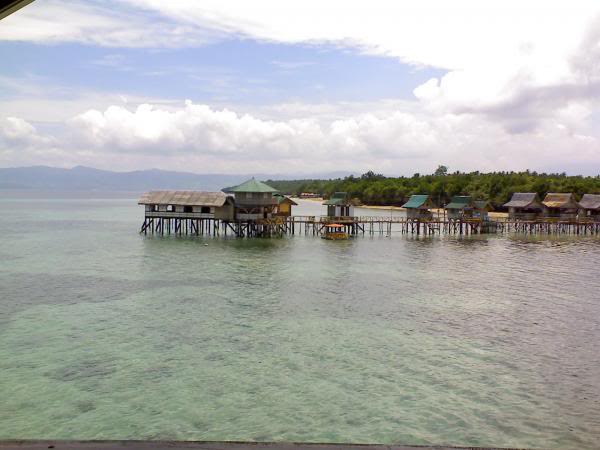
The Resort is widely popularity among locals and visiting tourists in view of the its unique design of long row of nipa and bamboo cottages perched on the bay that provide a stunning panoramic view of the surrounding calm waters and green mountains that enclose the Pujada Bay. It is an ideal weekend getaway for families to bond, groups of friends to simply hang-out, or business associates and office colleagues to meet. 

Perched on the crystal clear waters of Pujada Bay

The Resort has several beautifully designed open and closed cottages and stilt huts perched on the crystal clear waters of the beach, air-conditioned rooms, and a function hall for private occasions or business events. The Resort is also a jump-off point to nearby Waniban Island, Pujada Island and, the vanishing Oak Island for island hopping adventures via motorized boats.

Cottages and stilt huts

How to get to Gregorio Dita Beach Resort

The Resort is located in Sitio Masao, Barangay Tamisan in the City of Mati, Davao Oriental, approximately 18 kilometers, or about 30 to 45 minute drive from downtown Mati through unpaved, sometimes rough but manageable roads.


For more information, please contact

Gregorio Dita Beach Resort
Sitio Masao, Barangay Tamisan, City of Mati, Davao Oriental
Tel 0919 775 1712

Saturday, August 11, 2012

Carmelite Monastery in Mati, Davao Oriental

Carmel of St. Teresa of Jesus Monastery in Mati

This is the Carmelite Monastery in Sitio Tuatua, Barangay Matiao, City of Mati, Davao Oriental. Also called Carmel of St. Teresa of Jesus Monastery, it was founded in November 21, 1987. The monastery has a total land area of 16 hectares and features a Prayer Garden where life-sized statues of the Virgin Mary, the Archangel Gabriel, and tableau depicting the different mysteries of the Rosary, from the birth of Jesus Christ to His resurrection. It is about 100 meters away from the church and can be reached by crossing a hanging bridge thereat. The statues and tableau were sculpted by Bicolano sculptor José Barcena.
The Monastery is a popular destination during Holy Week. People go there to hear Holy Mass, to pray, meditate, and offer petitions, or simply have quality bonding moments with families, friends or colleagues. It is also a favorite playground for kids.

The Altar

How to get to Mati City

Mati can be reached by taking any of the daily scheduled airline flights from Manila to Davao City, or via a regularly scheduled inter-island vessels that ply the Manila-Davao City routes. From Davao City, the easiest way to get to Mati is through the Madaum diversion road which is shorter than the Davao-Tagum highway via private transportation or overland bus ride bound for the City of Mati - approximately 165 kilometers, or about 4 hours drive from the Davao Ecoland Bus Transport Terminal in Davao City.
Church Exterior

For more information, please contact

Carmel of St. Teresa of Jesus Monastery
P.O. Box 29 
Mt. Carmel, Sitio Tuatua, Barangay Matia
Tel +6387 388 3452


Carmelite Monastery in Mati

Friday, August 10, 2012

Dahican Beach

Dahican Beach in Mati, Davao Oriental - the Surfing Mecca of Davao Region

Dahican Beach is a stunning seven-kilometer stretch of crescent-shaped white sand coastline and towering coconut trees along the sparkling turquoise waters of Mayo Bay facing the Pacific Ocean. It is situated 10 kilometers of downtown city proper of Mati in Davao Oriental, and is a widely popular beach destination for skimboarding and other watersports in Davao Region. About a hectare of the bay is a declared marine sanctuary because of its rich marine life, and where dolphins, sea cows, and sea turtles inhabit the waters of Dahican. It is also home to the famous Amihan Boys of Dahican - a group of young homegrown skimboarders and surfers.

Dubbed as the "Surfing Mecca" of Davao Region, the strong waves, towering to about 10 feet, that hit the shoreline of the beach, are just about the perfect kind of waves surf and skimboard aficionados are looking for - moderately strong but not too much. The cold wintry breeze dominates the season in Dahican beginning sometime in September or October and ends sometime in May or June, during which the waves for surfing and skimming are at its peak. Although the waves and currents can be strong and treacherous during the monsoon months, Dahican Beach is still a perfect spot for skimboarding.

Entrance to the beach is FREE and it is open to anyone. However, there are no accommodations for overnight stay at the beach, nor restaurants or convenience stores nearby and bringing of food and drinking water is encouraged. Pitching of tents is allowed for a small fee and a hammock may also be rented. The Amihan Boys surf shack's kitchen may be used for cooking and does not carry any charge. However, bringing of own supplies such as charcoal and the like is also encouraged. There are other resorts along the coast of Dahican such as the Botona Beach Resort, Kubo sa Dahican, and Kanakbai which are a kilometer or two away.

How to get to Dahican Beach

Dahican Beach is easily accessible by any means of transportation through mostly paved with occasional rough roads, and is only about 15 minutes away from the downtown city proper of Mati, some three to four hours drive from Davao City.

For other information about Dahican and other places of interest in Mati, the City Tourism Office may be reached at +6387 3883-234, or through their E-mail address: matitourismoffice@yahoo.com

Monday, August 6, 2012

Sambuokan Festival


October is a merry month in the City of Mati in Davao Oriental as the Matinians celebrate their most colorful and much awaited Sambuokan Festival. It is a week-long celebration of the people of Mati in thanksgiving for the year's blessings of bountiful harvests and in observance of the founding anniversary of the City every 29th of October.

Sambuokan is a Mandaya word taken from the term "buok" which means "one" meaning unity and oneness among the people of Mati. Mandaya is an indigenous tribe in Mindanao that inhabits mostly the hinterlands of Davao Oriental. 

The Festival proudly showcases Mati’s oneness and harmony for a common good despite its diverse culture and ethnic traditions, denominations, economic status, and lifestyle by featuring a week-long merrymaking of nightly shows and events, and fun-filled activities such as street dancing competitions called "Indak Indak sa Sambuokan," one of the Festival's highlights that brings together the best contingents from elementary, secondary, and tertiary participants from Mati City and some parts in Mindanao and present an amazing display of their distinctive colors, cultures, and traditional dances starting from the ER Supermall, to Rizal Extension and main thoroughfares of downtown area, to the Mati Park and Baywalk as final area for showdown.

Indak Indak sa Sambuokan

Other events include Thanksgiving Mass, boxing invitationals, concerts, musical showdown, trade fair and exhibits showcasing the City's top quality products, dog show and clinic, beach parties, beauty pageant, fun run, photo competition, banca race, Frisbee events, bikini open, and skimboarding competition in one of Mati's stunning white sand beaches and crystal clear turquoise waters in Dahican beach. 
Sambuokan Festival was founded in 2001 by the late Edith Nakpil Rabat, a crowned beauty queen (Ms. Philippines 1956), a former assemblywoman, and wife of the late Francisco G. Rabat, former Vice Governor (1972-1975) and Governor (1978-1985) of Davao Oriental, and former Mayor of Mati City (2001-2007). Their daughter, Michelle Rabat, is the incumbent Mayor of Mati.
Edith Nakpil Rabat came from an impressive lineage: she was daughter to Anita Agoncillo Noble, also a crowned beauty queen (the first Ms. Philippines 1926), and Juan Nakpil, National Artist for Architecture, whose father was Julio Nakpil, first secretary of Andrés Bonifacio and composer of the Philippine National Anthem, and mother, Gregoria de Jesús, the Lakambini of the Katipunan and widow of Andrés Bonifacio.

The Festival is a collaborated effort of the City Government of Mati, the Sangguniang Panlungsod with the City of Mati Tourism Office, and supported by various civic groups, and private organizations - All for the People of Mati.


For more information, please visit


City of Mati Official Website www.mati.gov.ph
City of Mati Facebook Page

Images courtesy of the City of Mati and SSC-Davao

Sunday, August 5, 2012

Guang-Guang Mangrove Park and Nursery


Guang-Guang Mangrove Park and Nursery, also called Guang-Guang Marine and Research Center, is a protected mangrove forest spanning 21,000 hectares in Sitio Guang-Guang, Barangay Dahican in Mati, Davao Oriental where 18 of the rarest and endangered mangrove species in the Philippines are found and nurtured. A joint project of Guang-Guang Community and the Philippines' Department of Environment and Natural Resources or DENR, this vast mangrove forest provides good yielding grounds and habitat for marine lives like sea turtles. 

Here, many families, visitors, and tourists gather to spend a day of swimming, or simply hanging-out and experience the calmness of the mangrove's brackish waters. Families would bring their own tables and chairs and share meals in a picnic.

How to get to Guang-Guang Mangrove Park and Nursery

The Mangrove Park is situated in Sitio Guang-Guang, Barangay Dahican in Mati, Davao Oriental and it is easily accessible by private or public transportation. Barangay Dahican is about 25 minutes to half an hour from downtown Mati where several pedicabs or single motorcycles are readily available for hire.

Saturday, August 4, 2012

Cinco Masao Beach Resort

Cinco Masao Beach Resort

Cinco Masao Beach Resort is one of the two popular beach destinations situated along the shoreline of Pujada Bay in Sitio Masao, Barangay Tamisan, Mati, Davao Oriental. The other resort is the Gregorio Beach Resort. Although Cinco Masao started its operation only in 2001 by its owner, Mr. Vic Cinco, the Resort has gained a strong popularity among locals and visiting tourist in view of the Resort's unique design of long row of red-roofed cottages perched on the bay that afford a stunning 360-degree view of the surrounding calm waters and green mountains that enclose the Pujada Bay. It is a perfect weekend getaway for families to bond, groups of friends to simply hang-out, or business associates and office colleagues to meet.

The Resort has 20 beautifully designed cottages, 4 air-conditioned rooms, 10 guestrooms, a function hall that is ideal for private occasions or business events, a restaurant that serves delectable dishes and a souvenir shop. They also provide motorized boats that can be hired for island hopping to Waniban Island, Pujada Island and, the vanishing Oak Island.   

How to get to Cinco Masao Beach Resort

The Resort is located in Sitio Masao, Barangay Tamisan in Mati, Davao Oriental, about 30 to 45 minute drive from downtown Mati through unpaved, sometimes rough but manageable roads. 

For more information, please contact

Cinco Masao Beach Resort
Barangay Tamisan, Sitio Masao, Mati City, Davao Oriental
Mobile 0928 282 4304 | 0918 756 0571 

Friday, August 3, 2012

Mati City

Sambuokan Festival in Mati City celebrated every October

Mati City is the capital and only city in the province of Davao Oriental in Mindanao, Southern Philippines. It has a total land area of approximately 682 square kilometers or 263.32 square miles, with an estimated population of about 126,143 as per the 2010 Census. The City belongs to the Second District of Davao Oriental under Davao Region. Residents of Mati are called Matinians.

The word "Mati" is derived from the Mandayan word "Maa-ti" which refers to the town's creek that dries up easily even after a heavy downpour of rain. The pioneer settlers were the tribes of Kalagan, Mandayan, and Maranao which carries strong Arabic and Indo-Malayan influences. 

The city’s major dialects are Cebuano, Mandaya, Boholano, and Kalagan. Majority of Matinians speak and understand English and Tagalog.


Provincial Capitol of Davao Oriental is Located in Mati City

Mati was founded in 1861 by Captain Prudencio Garcia, the pioneer political-military head, and his comrade Juan Nazareno. By 1903, Mati was declared a municipality by virtue of Act No. 21, and subsequently in 1907, Act No. 189 further reaffirmed the establishment of its local government where Bonifacio Serrano was the first appointed mayor while Patricio Cunanan was the first elected mayor in 1923. Mati became the capital of Davao Oriental since 1967. 

On June 20, 2007, Mati was officially proclaimed a city by virtue of Republic Act 9408 converting the Municipality of Mati into a component city to be known as City of Mati.

An old painting of the Bay of Mati

Old Photo of Mati Wharf

The City of Mati is politically subdivided into 26 barangays: Badas, Bobon, Buso, Cabuaya, Central (City Proper or the Poblacion), Culian, Dahican, Danao, Dawan (then known as Cabuaya in 1957), Don Enrique Lopez, Don Martin Marundan, Don Salvador Lopez, Sr., Langka, Lawigan, Libudon, Luban, Macambol, Mamali, Matiao, Mayo, Sainz, Sanghay, Tagabakid, Tagbinonga, Taguibo, and Tamisan. 


Mati is the country’s coconut capital whose economy is highly dependent on the coconut industry and other agriculture products and agro-industries. Products such as bananas, pineapples, coconuts and fish are abundant and exported to other countries with linkages to Mindanao, Malaysia and Indonesia. Large deposits of copper also contribute much to the city's economy. Mati is also known for its furniture making and industrial tree plantations. 

The City is also widely known for its natural wonders and white sand beaches, and because of its stunning landscapes and unspoiled resorts, Mati is a major tourist destination in the region. Dahican, with its 17-kilometer shoreline of powdery white sand beach, is one of the most popular destinations in Mati and a favorite hub in the region for water sports activities such as skim-boarding, surfing, scuba diving, snorkeling, beach volleyball, and Frisbee.

Dahican Beach

Pujada Bay boasts of 15,700 species of marine life and has been considered as among the richest bays in South East Asia where lobsters, sea cows (locally known as Dugong), bottlenose dolphins, hammerhead sharks, manta rays, and different kinds of turtles abound in the bay. It is a marine protected sanctuary for these wonderful sea creatures.

Pujada Bay

The City of Mati celebrates two annual grand festivals: the Pujada Bay Festival which is held every June and Sambuokan Festival every October. Both festivals are relatively new; the Pujada Bay Festival started only in 2004 as a way of promoting and protecting the Pujada Bay, while Sambuokan Festival started in 2001 as a means to unite Matinians during the commemoration of the city's founding anniversary every 29th of October.

Pujada Bay Festival


Sambuokan Festival

Zig-zag Road to Mati

Badas Road to Mati

Mati as viewed from Badas

Lush greenery of Mati

Welcome Signage to Mati

Downtown Mati City

Street of Mati

Mati Municipal Hall

Mati Public Market

How to get to Mati City

Mati can be reached by taking any of the daily scheduled airline flights from Manila to Davao City, or via a regularly scheduled inter-island vessels that ply the Manila-Davao City routes. From Davao City, the easiest way to get to Mati is through the Madaum diversion road which is shorter than the Davao-Tagum highway via private transportation or overland bus ride bound for Mati City - approximately 165 kilometers, or about 4 hours drive from the Davao Ecoland Bus Transport Terminal in Davao City.

For more information, please visit

Official Seal of the City of Mati

City of Mati Official Website mati.gov.ph
City of Mati Facebook Page
Related Posts Plugin for WordPress, Blogger...