Standing only at 5 feet 4 inches, Army 2nd Lt. Christy Isis "Ice" Achanzar, a native of Davao, made history in May 31, 2008 as the first Filipina to graduate from the male-dominated United States Military Academy (USMA) in West Point, New York. She is also the first female cadet from the country’s premier military school, the Philippine Military Academy (PMA) to enter Westpoint. She also earned the prestigious Superintendent's Award for Achievement, an award of gold wreath insignia bestowed to the top 20 percent of cadets who excel in academic, military and physical programs of USMA.
2nd Lt. Achanzar was born in Davao City on September 28, 1981 to proud parents Ermine, government employee and a native of Cagayan, and Asuncion of Davao, a Catholic lay minister. She is the fourth of six children - four girls and two boys. She finished her high school at the Davao City National High School in 1998, and graduated with a Bachelor of Science degree in Electronics and Communications Engineering (BSECE) from the University of the Immaculate Conception in Davao. Achanzar was a power forward in her college's basketball team.
Immediately after graduation, and instead of pursuing a career in engineering, she applied as a cadet at the Philippine National Police Academy (PNPA) and the Philippine Military Academy and passed the qualifying tests of both academies but decided to enter the PMA.
In her Plebe year at the PMA, she, along with the top 50 of her class, took the initial entrance test for Foreign Exchange Cadet conducted by the US Army Defense Attache’s office. The number whittled down to 16, all of whom underwent a series of interviews with the respective US service academies. She and the others took the physical tests as well as the Scholastic Assessment Test (SAT) and Test Of English as a Foreign Language (TOEFL) examinations. Achanzar was in summer training at Fort Magsaysay in Laur, Nueva Ecija when the results came out in April 2004.
After passing all the examinations, she, the only female who qualified, immediately left for the United States and entered the US Military Academy at West Point in June 2004, almost 30 years after the USMA began admitting female cadets in 1975 in the academy's over two centuries of the existence. Achanzar was the first Filipina to be admitted to USMA.
While in military training at USMA, she also pursued Electrical Engineering as her major. Her group won in the world level IT engineering design at Institute for Soldier Nanotechnologies 2008 Soldier Design Competition at the Massachusetts Institute of Technology on April 17. She is also a member of the West Point Catholic Choir that performed two hymns during Pope Benedict XVI's visit to the United States. Achanzar is among the 970 members of the USMA's graduating class of 2008, and among the 17 foreign nationals from 14 countries.
In July 2008, Achanzar reported to then AFP Chief-of-Staff General Alexander Yano for active service and was admitted into the Philippine Army with the rank of second lieutenant. Her first assignment was a teaching job at the PMA.
Just like any city in the Philippines, Davao Cityis not lacking of informal settlers residing alongside waterways, rivers and in the coastal areas. But the BIG difference is, you wont find in Davao any trash, rubbish, or garbage floating anywhere on the city's waterways.
It will also be noted on-board the banca are 17 passengers which is clearly in compliance with the boat's maximum authorized passenger capacity of "20" persons as printed on it's starboard.
The above photograph simply mirrors the remarkable discipline of Dabawenyos - the people of Davao.
This motorized banca plies daily across the Davao River from a village in SIR Matina to Magallanes Street in downtown Davao City. Crossing the river in one of these bancas is the shortest and cheapest route to the other side of town for those residing at SIR Matina - a village known for cheap boarding houses and lodgings. Whereas it takes more or less 10 minutes at peak hours to downtown via Bankerohan Bridge, riding in one of these bancas will only take less than five minutes to cross the river.
The Philippines is an archipelago of 7,107 islands with a total land area, including inland bodies of water, of about 300,000 square kilometers (120,000 square miles). Its coastline is approximately 36,289 kilometers (22,549 miles) long which makes the country with the 5th longest coastline in the world. And along the Philippine coastline are endless shores of powdery white sand beaches surrounded by crystal clear turquoise water with strong waves big enough for surfing and skimming.
Skimboarding, also known as skimming or skiffle boarding on the beach has gained much popularity among Filipinos having brought to the Philippines by an American tourist named Tim Garret who visited Tanauan, Leyte, a province in the Eastern Visayas region, to court a young local. While in Leyte, he went skimboarding at the beach in his free time which eventually caught the attention of the locals. In no time, almost every beach aficionados were now into skimboarding and, in view thereof, Leyte has earned the title of Skimboarding Capital of the Philippines. Since then, other provinces where there are beaches followed suit: Davao City, the Island Garden City of Samal, Davao Oriental, Sarangani, Surigao del Norte, Surigao del Sur, and Bicol. Some of them have hosted skimboarding competitions.
Today, this extreme water sport is already popular in the United States, Canada, Australia, Spain, China, Malaysia, Japan, and Singapore. And because the Philippines is widely known for its magnificent beaches, many tourists have come to the Philippines and found the shores of Dahican Beach - a popular skimboarding and surfing destination in the City of Mati, Davao Oriental - at the southeastern most part of Mindanao with its stunning seven kilometers of white sand beach and big waves facing the Pacific Ocean.
The coast in Dahican is very clean, and surfers and skimboarders are a common sight at the beach. It is home to the famous Amihan Boys of Dahican - a group of young homegrown skimboarders and talented surfers led by George "Kuya Jun" Plaza, a native of Dahican.
One day in 2002, Kuya Jun saw several Davao City skimboarders surfing the beach. Amazed at how their simple wooden boards carried the surfers atop the three-metre waves, he built a plywood skimboard and began practising. The visitors gave one of their boards to the local boys, and Jun borrowed it regularly to perfect his skills. Despite suffering from a badly twisted wrist which he sustained in the course of practising his newly found watersport, Kuya Jun stubbornly refused to give up and further honed his surfing skills.
Since some local boys were also having fun in the waves, Kuya Jun gathered them and helped develop their skimboarding skills. Because of their talent and skill, the group of Kuya Jun gained popularity in Dahican and, at one time, seeing their plight, a Japanese tourist donated five surf boards worth over P50,000 each.
In 2004, Kuya Jun founded his now famous Amihan sa Dahican Skim and Surf Team and whenever opportunity presented itself, the Team competed vigorously in the beginners and expert categories and almost always emerged victorious against the best skimboarders from General Santos City in South Cotabato, Davao City, and Surigao del Norte, and contenders even as far as Leyte and Zambles - a province in central Luzon. He named the Team after the word "Amihan" which refers to "a cold wintry breeze" that dominates the season in Mati beginning sometime in September or October and ends sometime in May or June, during which the waves for surfing and skimming are at its peak. Although the waves and currents can be strong and treacherous during the monsoon months, Dahican Beach is still a perfect spot for skimboarding.
Over time, the Team's string of winnings in regional competitions gained for them much popularity in the growing skimboarding community and reputation of being one of the best in the country today. They have found their way to the front pages of local dailies and Kuya Jun was even featured in the Everyday Heroes section of Readers Digest Asia, October 2010 issue.
Despite the Team's achievements and strong support from the local government and popularity among the surfing community, they remained humble - a trait that Kuya Jun has strongly imbued in each member of the Team. He acts as a father to them, most of whom are sons of fisher folks in the village. Ranging from ages nine to 16, in the elementary and high-school, the Amihan Boys learned from their mentor discipline and good manners as a way of life, away from such vices as drugs, smoking, and drinking. Anyone breaking the rules is either barred from practice or kicked out of the team.
As early as 5 AM, they usually start the day by cleaning the beach and do other chores as cooking and cleaning the dishes. Skimboard and surf lessons are held after school and on weekends. A hectare of Dahican waters was recently declared a marine sanctuary by the local government of Mati because of their efforts in maintaining the cleanliness of the beach.
Kuya Jun has also built a surf shack made out of bamboo and nipa, some driftwood and spare plywood from their hand built skimboards and called it the Tourist Assistance Center. Here, they assist and act as guide to tourists and provide free skimboarding lessons and sponsor surfing clinics, hand build surf boards and sell them to fund the Team's travel and equipment costs.
Kuya Jun and the Amihan Boys of Dahican have indeed become role models to the youth of the City, spearheading several surfing tournaments and promoting not only good behavior and sportsmanship, but the city's tourism industry as well.
Dahican Beach is easily accessible by any means of transportation through mostly paved with occasional rough roads, and is only about 15 minutes away from the downtown city proper of Mati, some three to four hours drive from Davao City.
While there are other resorts along the Dahican coast such as the Botona Beach Resort, Kubo sa Dahican, and Kanakbai, there are no accommodations for overnight stay at the beach, nor restaurants or convenience stores nearby and bringing of food and drinking water for the entire duration of the stay is encouraged. However, pitching of tents is allowed for a small fee and a hammock may also be rented. The surf shack's kitchen may be used for cooking and does not carry any charge. However, bringing of own supplies such as charcoal and the like is also encouraged. Entrance to the beach is FREE and it is open to anyone. Visitors may need not bring their own boards, since there are skimboards and surfboards available at the site.
For other information about Dahican and other places of interest in Mati, the City Tourism Office may be reached at +6387 3883-234, or through their E-mail address: matitourismoffice@yahoo.com
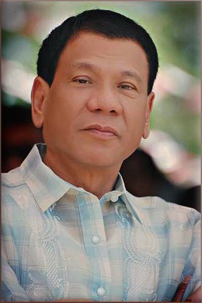
To this day, it is my firm belief that the impressive progress and much success of Davao City over the years and all the other unique qualities that make Davao City what it is today is largely due to the strong and benevolent leadership of none other than its former mayor, The Honorable Rodrigo R. Duterte, (now vice-mayor), and equally the peace-loving disciplined Dabawenyos who faithfully support him and for whom Duterte has dedicated his entire life as the city's most loyal public servant.
Born Rodrigo Roa Duterte on March 28, 1945 at Maasin, Leyte, to parents, Vicente G. Duterte and Soledad R. Duterte, public service is not something entirely new to him; his father (now deceased) was Governor of Davao in the 1950s, and his mother, who is fondly called, "Nanay Soleng", was a school teacher and a civic leader who once headed former President Corazon Cojuangco-Aquino's "Yellow Friday Movement" and the regionalized peace process with the communists in the 1980s.
Duterte was just like any other kid according to Nanay Soleng but adventurous in ways that other kids would not even dare or venture into. He was always out of the house looking for some action elsewhere. When Duterte was a young teenager at age 14, he piloted a small plane hovering about the neighborhood to the consternation of his parents. He was such a problem child that his father exiled him to Digos, Davao del Sur, where he finished high school in Holy Cross of Digos in 1966. Duterte graduated law at San Beda College in Manila under Class 1972, and passed the bar examination in the same year. He then had a short stint as lecturer on Criminal Law, Criminal Evidence and Criminal Procedure at the Philippine National Police Academy Regional Training Center XI before joining the government as prosecutor at the Davao City Prosecution Office from 1977 to 1986. He was then appointed officer-in-charge (OIC) vice mayor and had served as special counsel where he prosecuted cases involving police and military personnel, including subversion and rebellion cases filed against alleged members of the New People's Army (NPA), until he became assistant fiscal after the 1986 EDSA Revolution in Manila - a popular non-violent uprising known as "People Power Revolution" (February 22-25, 1986) that overthrew the 20-year dictatorship of President Ferdinand E. Marcos and installed Mrs. Corazon C. Aquino as President, mother of now incumbent President Benigno Simeon "Noynoy" C. Aquino III.
Even while Martial Law was still in effect in the entire country at that time, Duterte was known to be fearless, recommending prosecution of abusive police and military personnel. He is never afraid of criminals. He was even known to have kicked a man in the chest inside the court room which landed him in jail.
In 1988, Duterte ran for mayor and won. Since then, he never lost an election bid. As mayor, he not only ran after criminals in the city, but was instrumental in uniting the different tribes and cultures in Davao, as well as the other political groups. He designated deputy mayors that represented the Lumads and Moro in the city government, a first in the country which was later copied in other parts of the country. He was reelected mayor in 1992 and 1995. In 1998, he ran for the House of Representatives and won as Congressman for the 1st District of Davao City until 2001. In 2001, he ran again for mayor in Davao and was again elected for his fourth term. He was reelected in 2004 and in 2007. He is currently the vice mayor of Davao City, with his daughter Sarah "Inday" Duterte-Carpio taking his place as mayor.
"Digong", as his closest friends call him, or "Rody", or simply, "Duterte", may have ruled Davao City with what some call "iron-fist", and rid the city of criminals. His hatred for criminals changed Davao City; from the "Murder Capital of the Philippines" to the "One of the Most Peaceful Cities in the Philippines". Under his leadership, Davao earned a string of awards, both local and international, year after year. Duterte, who has been nicknamed "The Punisher" by Time magazine, has been criticized by human rights groups and by Amnesty International for tolerating extrajudicial killings of corrupt officials and criminals, but unknown to many, deeply hidden behind all the tough persona lies a kindhearted man with an ever soft spot for the poor, whose plight he has always championed. His effectively governance has not only brought prestige, and honor, but also the much needed investments to the city which now provide numerous jobs to all Dabawenyos. Duterte has also implemented landmark laws and city ordinances being the ever first mayor in the Philippines to enforce a city-wide ban on smoking in public places. He also banned the use of fireworks in the city. He strictly implemented a policy that prohibits selling of alcoholic drinks from 2AM to 6AM. He also created the first and only 911 Emergency hotline in all of Asia - a search and rescue unit, and fire and medical emergency response teams for Davao City.
Personal Information
Name: RODRIGO ROA DUTERTE
Date of Birth: March 28, 1945
Place of Birth: Maasin, Southern Leyte
Father : Gov. Vicente G. Duterte (deceased)
Mother : Soledad R. Duterte
Marital Status : Married
Name of Children : Paolo, Sara, Sebastian, and Veronica
Occupation : Lawyer
School : San Beda College - Class 1972 - Bar 1972
Educational Attainment
Elementary - Sta. Ana Elementary School, Davao City (1956)
High School - Holy Cross of Digos, Davao Sur (1966)
College - Bachelor of Arts in Lyceum of the Philippines, graduated 1968, and Bachelor of Laws
at the San Beda College, graduated, 1972
Work Experience
Lecturer on Criminal Law, Criminal Evidence & Criminal Procedure, Police Academy Regional Training Center XI, 1973
Special Counsel – City Prosecution Office, Davao City, 1977-1979
Fourth Assistant City Prosecutor, City Prosecution Office, Davao City, 1979-1981
Third Assistant City Prosecutor, City Prosecution Office, Davao City, 1981-1983
Second Assistant City Prosecutor, City Prosecution Office, Davao City, 1983-1986
Vice-Mayor,Davao City, 1986 - 1988
Elected City Mayor, Davao City, 1988 - 1992
Re-elected City Mayor, Davao City, 1992 - 1995
Re-elected City Mayor, Davao City, 1995 - 1998
Elected Congressman, 1st District of Davao City, 1998 - 2001
Elected City Mayor, Davao City, 2001 - 2004
Re-elected City Mayor, Davao City, 2004 - 2007
Re-elected City Mayor, Davao City, 2007 - 2010
Elected Vice Mayor, Davao City, 2010 - Present
Affiliations in Organization
Member, Integrated Bar of the Philippines
Member, Davao Lions International - Chinatown chapter
Member, Davao Practical Shooting Association
Member, On Any Sunday Riders
Davao City Awards and Citations:
* MOST CULTURE-FRIENDLY CITY IN THE PHILIPPINES (2009)
* ONE OF THE 20 MOST LIVABLE CITIES IN ASIA
In the annual survey made by Asiaweek on the 40 Best cities in Asia, Davao City has unfailingly made it to the top for four consecutive years (1996-1999).
* THE PHILIPPINES’ MOST LIVABLE CITY
One of the Only Three Areas in the World to have the Integrated emergency Response System 911 as Top 25 Best Practices in the Philippines.
Davao City is one of only three areas in world, after the United States and Canada to have the Integrated Emergency Response System 911, a fully computerized response system linking the people of the city to the emergency resources of the government.
Davao City received an award for its Project 911 from the League of Cities in the Philippines in 2003, as one of the Top 25 Best Practices in the Philippines.
* TOP DESTINATION OF THE YEAR, Kalakbay Awards (1997)
* CLEANEST AND GREENEST HIGHLY-URBANIZED CITY IN THE PHILIPPINES
Davao City received an award of excellence from the Office of the President as the 1st Runner-up in the Cleanest and Greenest Highly-Urbanized City in the Philippines-Gawad Pangulo sa Kapaligiran Awards 2004, and the second runner up for three consecutive years in 2001-2003.
* CLEANEST AND GREENEST CITY IN 1999
Davao City was awarded the Cleanest and Greenest City in 1999 for its clean and green program that focus on environmental rehabilitation, protection and conservation, intensification of solid waste management program, pollution control, re-greening of the urban areas, forest and watershed management.
* MOST CHILD-FRIENDLY CITY IN THE PHILIPPINES
Davao City came out as the runaway choice for the coveted spot in the first-ever selection of the Most Child-Friendly City in the Philippines in 1988 and 1999 due to its local government’s programs and initiatives directly benefiting the children.
It has also won nods for the initiative to pass a landmark legislation - the Davao City Children’s Welfare Code of 1994, the first of its kind in the country, specifically geared towards addressing the rights, services and protection of children, therefore upholding their welfare and interests in high regard.
* MOST COMPETITIVE CITY TO DO BUSINESS IN THE PHILIPPINES
In 2002, Davao City was recognized as the Most Competitive City to do Business in the Philippines by the Asian Institute of Management (AIM) Policy Center and the Department of Trade and Industry in their assessment of Philippine Cities Competitiveness. In 2003, Davao was also chosen 3rd Most Competitive Metro City in the Philippine Cities Competitiveness ranking.
* MOST GENDER RESPONSIVE LGU IN THE PHILIPPINES
Gawad Galing Pook 2004 Awardee
National Commission on the Rights for Women (NCRFW) Award for Gender Responsive Local Governance 2005
* HALL OF FAME, BEST PEACE AND ORDER COUNCIL IN THE PHILIPPINES
The National Peace and Order Council of the National Police Commission placed Davao City in the Hall of Fame in 2004 for winning Best Peace and Order Council in Region XI for three consecutive years (1999-2002). It is recognition of Davao City’s sustained and exemplary accomplishments in implementing programs and projects of the Peace and Order Councils (POC’S) at various levels.
* MOST OUTSTANDING LGU: Regional Literacy Awards and 2nd Place in the 2005 National Literacy Awards
The Department of Education hailed Davao City as the "Most Outstanding Local Government Unit in the 2005 National Literacy Awards”, all under the Highly Urbanized City Category.
* REGIONAL GREEN BANNER AWARDEE
The National Nutrition Council of the Department of Agriculture awarded Davao City the "2004 Regional Green Banner" in recognition of the City Nutrition Committee’s exemplary performance in managing the nutrition program of the city, thereby contributing to the improvement of the nutritional status of its constituents.
* TOP GOVERNMENT WITHHOLDING AGENT
The Department of Finance, Bureau of Internal Revenue, Revenue Region 19, Revenue District No. 113, Davao City recognized the City Government for its invaluable support and contribution to RDO 113 as the "Top Government Withholding Agent" by making substantial tax payment - an act of patriotism worthy of recognition and commendation.
* TOP TOURIST DESTINATION IN THE PHILIPPINES
Davao City was chosen “Destination of the Year” by the Kalakbay Awards in 1997.
* MOST OUTSTANDING CHAMBER OF COMMERCE IN THE PHILIPPINES AND IN ASIA PACIFIC REGION
The Davao City Chamber of Commerce and Industry, Inc. (DCCII) was bestowed the "Most Outstanding Chamber Award for 2005" . DCCII was likewise recognized as the "Best Chamber in the Asia-Pacific Region" during a selection held in New Delhi in 2005.
* MOST OUTSTANDING KBP CHAPTER IN THE PHILIPPINES
The Kapisanan ng mga Brodkaster ng Pilipinas acknowledged its Davao City local chapter as the "Best KBP Chapter for 2004." It was once again given recognition for winning "2nd Place for the Best Local Chapter Report."
* CLEANEST AIR IN THE WORLD-MEMBER OF THE CLEAN CITIES COALITION
In 2005, Davao City was launched as the second pilot area of the Clean Cities Program (CCP) implemented by the Sustainable Energy Development Program (SEDP), in partnership with the US Department of Energy (USDOE) and the US Agency for International Development (USAID).
Victorio C. Edades (1895-1985) Philippine National Artist Father of Modern Philippine Art
This special post is dedicated to a great Filipino master who spent his retirement years with his family in Davao City from 1967 until he breath his last on 1985 at age 89. He was a Philippine National Artist, and co-founder of the Mindanao Ethnoculture Foundation that focused on the indigenous culture and heritage of Mindanao. He was Victorio C. Edades, "Father of Modern Philippine Art."
Born on December 13, 1895 in Barrio Bolosan in Dagupan, Pangasinan, Victorio Edades was the youngest of ten children, six of whom died from smallpox epidemic shortly before the turn of the 20th century.
Edades' artistry began at an early age. He obtained his early education in barrio schools and went to a high school in Lingayen, Pangasinan. By seventh grade, his teachers were so impressed with his talent that he was fondly named, "apprentice teacher" in his art class. He was very good in class from the very beginning, having earned several awards in school debates and writing competitions.
University of Washington in Seattle, USA
In 1919, after high school, Edades left for the United States to study arts. He initially worked in salmon canneries in Alaska and eventually moved to Seattle where he took up Architecture at the University of Washington and earned a Master of Fine Arts in Painting. It was also during his stay in the U.S. that he married American Jean Garrott, with whom he had his only daughter, Joan.
While in the United States, he saw numerous artworks of modern European artists such as Cézanne, Matisse, Picasso, and the Surrealists exhibited at the New York Armory Hall. Edades found that the artworks were a complete departure from the conventional Impressionistic and Realistic works of arts that were traditionally presented in refined detailing and visual fidelity. He was so deeply impressed with the modernist style that he began to paint in the modern manner. This new style allowed him freedom to fill his canvases with artistic expressions in his own way.
Back in Seattle, Washington in 1925, Edades competed at the Annual Exhibition of North American Artists where his entry,"The Sketch" won second prize in 1927. (The painting now hangs on display at the Philippine National Museum in Manila).
The Sketch Oil on Canvas 96 x 117 cm
When Edades returned to the Philippines in 1928, he saw many of his contemporary fellow artists were doing similar themes painted in a limited technique that mostly followed Amorsolo’s style. Dismayed by what he saw, he launched a one-man show at the Philippine Columbia Club in Ermita, Manila in December 1928 and featured thirty of his most renowned paintings including those that won acclaim in the United States. The conservative Filipino art circle was apparently shaken by his artworks that not one painting was sold. His paintings were in contrast from the works of Amorsolo and the Classicists who painted bright cheery scenes of flawless Filipinos and their idealized daily routines. His were figures and images done in muddy earth colors - yellow ochres and raw sienna accented by bold black distorted contours whose proportions defy classical measure. Edades choice of subject caused quite a stir among his viewers and critics. His painting "The Builders" (1928) portrayed tough, dirty construction workers drenched in grime and sweat. The painting became known as the first ever Modernist painting in the country. Even his nude paintings were nothing like Amorsolo’s portrayal of the Filipina at her best. ("The Builders" is now part of the collection of the Cultural Center of the Philippines in Manila).
University of Santo Tomas Manila, Philippines
In 1930, Edades joined the University of Santo Tomas in Manila and helped organized the school's Department of Architecture. He was eventually appointed director of the university's College of Architecture and Fine Arts in 1935. Guided by the existing American curricula, he designed the first Liberal Arts curriculum which led to a Bachelor’s Degree in Fine Arts, a first in the Philippines since art was only taught in vocational schools then. Subjects such as, Drawing, Painting and Composition, including Western and Oriental Art History, foreign languages, and elective science subjects such as Zoology and Botany were standard to the curriculum. Owing to the immense contribution of Edades, the University of Santo Tomas became the forerunner of Modern Art in fine arts education in the Philippines and has produced generations of artists who have dominated the Philippine art scene.
The Gatherers (1965) Oil on Panel 46 x 35.5 cm.; 18 x 14 in.
Through his continuous propagation of his beliefs and ideas on Modern Art as shown in his artworks and teachings, Victorio Edades sparked a friendly debate between modern and academic (classical) arts with Ariston Estrada, Ignacio Manlapaz, and Fermin Sanchez. This was interrupted by the second World War, but resumed in 1948, with sculptor Guillermo Tolentino and painter Fernando Amorsolo representing the conservatives. In the pages of the Herald Mid-Week Magazine, Sunday Times Magazine, and This Week, Edades debated with Guillermo Tolentino, who spoke for the conservatives. The spirited exchange was very educational for readers and fostered appreciation of artistic and intellectual currents. Edades debated that the conventions and clichéd ideology of domestic art stunted the development of Philippine art, attesting that “art is ever the expression of man’s emotion, and not a mere photographic likeness of nature. Thus to express his individual emotion, the artist is privileged to create in that distinctive form that best interprets his own experience. And the distortion of plastic elements of art such as line, mass and color – is one of the many ways of expressing one’s rhythmic form.” Edades also explained that Modern Art is not anti-Classicist. He said, “From the technical point of view, Modern Art is an outgrowth of Classical Art. Modern Art is the interpretation of the Classical concept conditioned by the artist’s new experience with the aid of improved means of aesthetic expression.” By his defiance to the academic perception of art and determination to stand by his ideology, he made art available to the common man.
The Lavandera (1976) Watercolor 10" x 14 "
With the uproar Edades’ ideas raised, he knew that he cannot make a living by merely painting. So he went by producing commissioned works, particularly murals. He did murals for prominent individuals (like Juan Nakpil) and institutions. And in 1934, Edades invited fellow artists, Galo B. Ocampo and Carlos "Botong" V. Francisco to collaborate with him in a mural project for the lobby of the Capitol Theater in Escolta Street in Manila. This led to several other collaborative projects, and they eventually formed a group known as the Triumvirate of Modern Art. This began the growth of mural painting in the Philippines.
In 1937, Edades also traveled to Paris to observe and study the different modern arts, architectural design, and watercolor painting at the Atelier Colarossi and Ecole des Beaux Arts, Fotainbleau.
By 1938, Edades, along with Diosdado Lorenzo and Galo Ocampo, opened up the Atelier of Modern Art at the M. H. Del Pilar, in Malate, Manila. This resulted in the formation of the Thirteen Moderns, considered the pioneers of modern art in the Philippines. This group was headed by Edades and included such masters as Carlos Francisco, Galo Ocampo, Diosdado Lorenzo, Vicente Manansala, HR Ocampo, Anita Magasaysay, Cesar Legaspi, Demetrio Diego, Ricarte Purugganan, Jose Pardo, Bonifacio Cristobal and Arsenio Capili. This distinguished roster of artists was strongly committed to explore the modern style in Philippine art.
Edades also organized the School of Design with Juan Nakpil in 1940.
In 1961, Edades received the Pro Partia award during the Rizal Centennial Celebration of the same year, and in 1964, he was also given the Araw ng Maynila Award in Painting.
After serving many years as Director of the College of Fine Arts and Architecture, he retired from the University of Santo Tomas in 1965 at the age of 70, and was later bestowed with the degree of Doctor in Fine Arts, Honoris Causa on February 12, 1977.
Following his retirement from the University of Santo Tomas, Edades retired to Davao City with his American-born wife Jean and their only daughter, Joan. There, he spent most of his time at his garden in Davao, listening to Chopin as he painted and received friends. The many years that Edades spent at the university is foregrounded by the lush painting "UST Botanical Gardens", which emphasizes the master’s deep interest in gardening and horticulture. He also taught for a time at the Philippine Women’s College and resumed his career as an artist. His later works are said to be "flatter." His portraits and genre paintings in Davao are not seen to be as heavy or solid as his earlier painting of "The Builders." From Cézanne, Edades grew more interested in the style of Utamaro of Japan and other artists whose charm is in color rather than solidity.
Edades also co-founded the Mindanao Ethnoculture Foundation which focused on the indigenous culture and heritage of Mindanao. In his last fifty years, the subject of his paintings had also become indigenized.
And in 1976, at the pinnacle of his career, Edades was named Philippine National Artist for Painting.
On March 7, 1985, Victorio C. Edades - a great Filipino master and Father of Philippine Modern Art, leader of the revolutionary Thirteen Moderns, National Artist, and a distinguished retiree in Davao City, passed away at the age of 89, leaving behind him a legacy of distinct style of Philippine Modern Art - an art which had been an obvious awe to his contemporaries, an admiration to his followers, and will undoubtedly serve as an inspiration to the generations of budding Filipino artists in the many years to come.
Edades’ major works include:
• 1928 – The Sketch, National Museum Collection
• 1928 – The Builders, Cultural Center of the Philippines Collection
• 1935 – Interaction, with Carlos V. Francisco and Galo B. Ocampo
• 1976 – Demoiselles D’avao
• 1979 – Kasaysayan, a mural for a Manila bank
Achievements:
• 1961 – Pro Patria Award, given during the Rizal Centennial Celebration
• 1964 – Patnubay ng Sining at Kalinangan Award, from the City of Manila
Thirteen Moderns of Philippine Art
Victorio Edades
Carlos (Botong) Francisco
Galo Ocampo
Diosdado Lorenzo
Vicente Manansala
H.R. Ocampo
Anita Magsaysay-Ho
Cesar Legaspi
Demetrio Diego
Ricarte Puruganan
Jose Pardo
Bonifacio Cristobal
Arsenio Capili
The Thirteen Artist is named in honor of the pioneering group of thirteen modernist in Philippine art.
The Thirteen Artists Awards started as a curatorial project of the Cultural Center of the Philippines under its first museum curator Roberto Chabet. The award recognizes progressive, young artist who are chosen based on: a body of work characterized by artistic integrity; innovativeness and congency of ideas; responsive to contemporary realities; and sustained artistic ability demonstrated in individual and collective exhibitions. The Award is now given every three years.
ANG KIUKOK (1931-2005) 2001 National Artist of the Philippines for Visual Arts Outstanding Dabawenyo
Ang Kiukok, Philippine National Artist and master Filipino painter who attained prominence for his distinct fusion of cubist, surrealist, and expressionist concepts and undoubtedly one of the most dynamic figures in contemporary Philippine arts was a Dabawenyo.
Born on March 1, 1931 in Davao City, Philippines, Ang Kiukok was the only son among a brood of five daughters of Chinese immigrants from Fukien, Vicente Ang and Chin Lim. His father wanted to name him Hua Shing, meaning "Chinese-born", but decided to look for another name when he learned that his cousin's son had been given the same name. Anxious about China's fate against the invading Manchurians at that time, his father named him Kiukok, meaning "Save the Country".
University of Santo Tomas
Kiukok's artistry began at an early age. Even before he reached his teen years, he began drawing images of people using styles that were commonly seen in magazines and comics. Later, he trained in Chinese arts with particular focus in brush and ink. In 1952, he entered the University of Santo Tomas in Manila and studied Fine Arts until 1954 under fellow National Artist Vicente Manansala who become a lifelong friend and mentor. Victorio Edades, Diosdado Lorenzo, Jose Garcia Llamas, Carlos "Botong" Francisco, Galo Ocampo, Virginia Ty, and Italian sculptor Francesco Monti were his professors. Thereafter, he taught art in a school for children of overseas Chinese for five years.
Through the urging of his mentor Vicente Manansala, he launched his first one-man show at the Contemporary Arts Gallery in 1954. Since then, he has had many other solo exhibits throughout his career and earned a string of distinguished major awards along the way: a bronze medal at the First International Art Exhibition in Saigon in 1962, third prize in the Shell National Students Art Competition for Calesa in 1953, and won several awards from the Art Association of the Philippines for his works: Honorable Mention, "Still Life" (1951), First Prize, "The Bird" (1959), Third Prize, "Still Life in Red" (1963), Second Prize, "Fish" (1963), and Second Prize on "Geometric Still-Life Fish" (1963).
Fish
In 1961 he was awarded Outstanding Overseas Chinese in Art, and was conferred Outstanding Citizen by the City of Manila in 1976. He won the Patnubay ng Sining at Kalinangan Award in 1976 from the City of Manila, and was also given an Outstanding Alumnus Award by the University of Santo Tomas that same year. He was also awarded when one of his works became a finalist in the Mobil Art Awards in 1980. In 1990, he was featured in an art exhibit called Three FigurativeExpressionists held at the Cultural Center of the Philippines along with masters, Onib Olmedo and Solomon Saprid.
In 2001, he was named National Artist for Visual Arts by then president Gloria Macapagal-Arroyo for his figurative expressionist style.
Fish, 1958, Oil in Canvas 20 x 28 1/4 inches
The turning point of his career as an artist came in 1965 when he and the late Vicente Manansala went to New York. There, he was culture-shocked at the sight of stark alienation and dehumanisation in the American lifestyle. Since then, in different mediums such as oil, watercolor, pen and ink, he began filling his canvases with distinct abstract expressionist style of vivid, cubist figures and images of outrage and agony filled with anger, sorrow, ugliness and madness, which are grotesque and often morbid representation of life scenes, a factor unappreciated by many which slighted the commercial viability of his works until the 1980s when he firmly established himself as a top-seller. Since then, he enjoyed eminent success in the country and around Asia, with exhibits in Manila, Japan, Taiwan, Singapore, as well as in the Netherlands, Canada and the United States. He had become the best-selling Filipino artist in auctions locally and internationally at Southeby's and Christie's aside from Fernando Amorsolo, another National Artist.
Clown
Recently Ang Kiukok's paintings seem to have mellowed to less violent subjects such as harmless-looking clowns and richly-clad harlequins contorted comically or juggling balls. For many, he was regarded the epitome of cynicism. And yet, when one observes his artworks carefully, one may see his persona a cynic only because he is, primarily, an idealist.
Perhaps one of his greatest honors was when the Metropolitan Museum of Manila showcased a retrospective of his artworks in 2000. The exhibit was a rare distinction as this exulted privilege had only been granted to Fernando Amorsolo and Vicente Manansala before him.
Today, Ang Kiukok's artworks can be found in many major local and Asian art collections, among them the Cultural Center of the Philippines, Philippine National Museum, Ateneo Art Gallery, National Historical Museum of Taipei, and the National Museum in Singapore. He was one among the many great Filipino masters whose works are exhibited and showcased in various displays in Saigon, Tokyo, Taipeo, Kuala Lumpur, and Singapore.
On May 9, 2005, Ang Kiukok - great Filipino Artist, Master Painter, Visionary Genius, Pioneering Modernists, Figurative Expressionist, Dynamic Cubist, and Surrealist, National Artist and a Dabawenyo, succumbed to prostate cancer at the age of 74 in Quezon City, Philippines. He is survived by his wife, Mary de Jesus with whom he had four children. His body was buried at the Libingan ng mga Bayani, befitting to a great Filipino Master whose immense contribution in the field of Visual Arts earned him the admiration and respect of his contemporaries and countrymen.
Grave of Ang Kiukok at the Libingan ng mga Bayani
Ang Kiukok’s major artworks include:
• 1962 – Pieta, which won him the bronze medal in the 1st International Art Exhibition in Saigon
• 1969 – Geometric Landscape
• 1972 – Last Supper
• 1974 – Cockfight
• 1976 – Crucifixion
• 1979 – Seated Figure, which was auctioned at Sotheby’s, Singapore
• 1987 – Mother and Child
Awards and Citations:
• 1961 – Outstanding Overseas Chinese in Art Award
• 1976 – Outstanding Citizen, awarded by the City of Manila
• 1978 – UST Outstanding Alumnus Award
• 1978 – Patnubay ng Sining at Kalinangan Award, from the City of Manila
• 1980 – Mobil Art Award
• 2002 – Jose Rizal Award for Excellence, from The Manila Times and the Kaisa Foundation
Ang Kiukok's artworks are too many to be contained in this blog, and here are just some of the images of his major artworks which I have sourced from the Web:
Last Supper
Pieta
Still Life - FISH, 1965. Christie's (Sold for $11,660 in 2005)
Crucifixion, Oil on Canvas, 1969
FISH, 1979, 35 x 26 inches, Sotheby's (Sold in 2005)
Unknown to many, the man behind the phenomenal success of Jollibee is a Dabawenyo - Tony Tan Caktiong, Founder, Chairman and CEO of Jollibee Foods Corporation, the largest and most successful fast food chain and franchising network in the Philippines.
I met Tony Tan Caktiong in 1990 during the awarding of the JCI-Philippines' Ten Outstanding Young Men of the Philippines (TOYM) which was held at the Grand ballroom of the Philippine Plaza Hotel in Manila. He was an Awardee for Entrepreneurship. I was then Commissioner for Publications with the Makati Jaycees and was invited by the TOYM Chairman, Roberto A. Alvarez, Jr. of the Junior Chamber International Philippines (Philippine Jaycees) to chair the Publications, and Public Relations Committees. The position gave me the rare opportunity to meet and interview the TOYM Awardees that year including Tony Tan.
Atty. Ricardo "Dong" Puno was the Master of Ceremonies of the occasion while I, in turn, co-hosted with him and also headed the Jaycees' Reception Committee. I was even tasked to sing the "Lupang Hinirang", the Philippine National Anthem.
TOYM is the Philippines’ most prestigious awards search for a select elite group of young men and women between ages eighteen to forty who have shown selfless dedication for their work, passion for excellence and compassion towards the communities they belong.
Tony Tan Caktiong is the third of seven siblings born to poor parents who migrated from the Fujian province in China for greener pastures in the Philippines. His father started out as a chef in a Chinese Temple, and was later invited to open a restaurant in Davao where the whole family eventually moved to help manage the business which became profitable. While growing up in Davao, he and his brothers assisted in their family restaurant where their father was the chef. After high school, the young Tony returned to Manila and finished Chemical Engineering at the University of Santo Tomas. After graduating from the university, Tony and his brothers applied for a franchise of Magnolia Ice Cream House and in 1975, two outlets were opened: one was along Aurora Boulevard in Cubao, Quezon City and the other one was in Quiapo, Manila. While both outlets were doing well, the brothers noticed that their customers wanted more than just ice cream, so hamburgers, chicken, and spaghetti were added to the menu. By 1978, their operations expanded to six ice cream parlors. Soon thereafter, these hot meals were outselling ice cream which gave them the idea to transform these outlets into dine-in fast food restaurants.
In view of the increased demand in hamburgers, Tony Tan and his brothers shifted their focus from ice cream to selling hamburgers and incorporated themselves and named their restaurant, Jollibee! Since its incorporation in 1978, Jollibee has become a popular household name in the Philippines, even obscuring the popularity of McDonald’s, the largest American hamburger chain in the world.
The story behind the name "Jollibee" is as interesting as the company's fascinating history. When Tony Tan Caktiong and his family were brainstorming on the symbol for their business, they thought of a bee because it is known for its hard work and the honey it produces represents the sweet things in life. In addition, they also wanted the name to connote happiness and eventually prefixed "jolly" because they believe that people should be happy with their work to enjoy it at the same time. Thus, the brand name, Jollibee came about which has transformed from a mascot to a Philippine cultural icon.
Jollibee Foods Corporation has seen several milestones, reaching P500 million sales mark in 1984, joining in the Philippines' Top 100 corporations in 1987, breaking the P1 billion sales margin in 1989, and becoming the first food service company to be listed in the Philippine Stock Exchange in 1993. Today, Jollibee commands 65% of the market and leads in the three major segments - Jollibee in chicken and burgers, Chowking in oriental fast food, and Greenwich in pizza and pasta.
From its humble beginnings of two stores, it has grown to over 900 outlets in the country and 29 overseas, having businesses in the United States, Hong Kong and is continuing its expansion in China, Indonesia and exploring opportunities in the Japanese dining market. This phenomenon is due to Tony Tan's persistent drive to innovate, to look ahead, and to learn from other companies' successes and mistakes. He is known to be the toughest quality controller of Jollibee's products and services.
Good food and family are the two essential elements behind the phenomenal success of both Tony Tan Caktiong and Jollibee. He credits his parents for cultivating his entrepreneurial spirit and instilling in him the values of respect and humility, which are now ingrained in the corporate culture of Jollibee.
For his revolutionary entrepreneurship and immense contribution to the Philippine fast food industry, Tony Tan Caktiong has received several distinguished awards and citations:
Entrepreneur Of The Year Philippines, 2004
Ernst and Young Entrepreneur of the Year World, 2004
World Entrepreneur of the Year Award, 2004
Management Man of the Year in 2002
Agora Award for Outstanding Marketing Achievement
Triple A Alumni Award from the Asian Institute of Management
Golden Scroll Award
Ten Outstanding Young Men (TOYM) Award for Entrepreneurship
Star of Asia Award from BusinessWeek
Lifetime Achievement Award from the Asian Chain Restaurant Operators and Suppliers Series
In September 2004, on the occasion of its 80th founding anniversary, the Davao Central High School, popularly known as the Davao Chinese High School, has honored Tony Tan Caktiong as one of its three outstanding alumni for exemplifying and giving meaning to its scholastic tradition of academic excellence and for bringing honor and prestige not only for the school and the Chinese community but also to Davao City.
Business Interest
Jollibee Foods Inc., Founder, Chaiman, CEO
Tomi’s Teriyaki Japanese Restaurant
Chowking
Greenwich
Red Ribbon Bakeshop, Inc.
Delifrance Philippines
Manong Pepe’s
Yonghe King
CST
Jollibee Worldwide Pte. Ltd.
Belmont Enterprises Ventures Ltd.
Honeysea Corporation
Hyper Dynamic Corporation
Mainspring Resources Corporation
Mary’s Foods Corporation
Queenbee Resources Corporation
Honeybee Foods Corporation
Fresh N’ Famous Foods Inc
RRB Holdings, Inc.
Red Ribbon Bakeshop (USA)
First Gen Corporation
"The bee hops around, very busy, producing honey.
This represents life's sweet things.
Because even if you’re busy, you have to be very happy.
You have to be jolly.
Because if you're not happy, being busy is not worth it."